Private PEMF Therapy in Carmel, IN
Twenty quiet minutes, honestly described.
PEMF therapy at Ozwell in Carmel. A low-frequency pulsed electromagnetic field mat: you lie still for 20 quiet minutes, and you won't feel much while it runs. Research on PEMF for general recovery is early and mixed, so we offer it as a genuinely restful part of a recovery day rather than as a treatment.
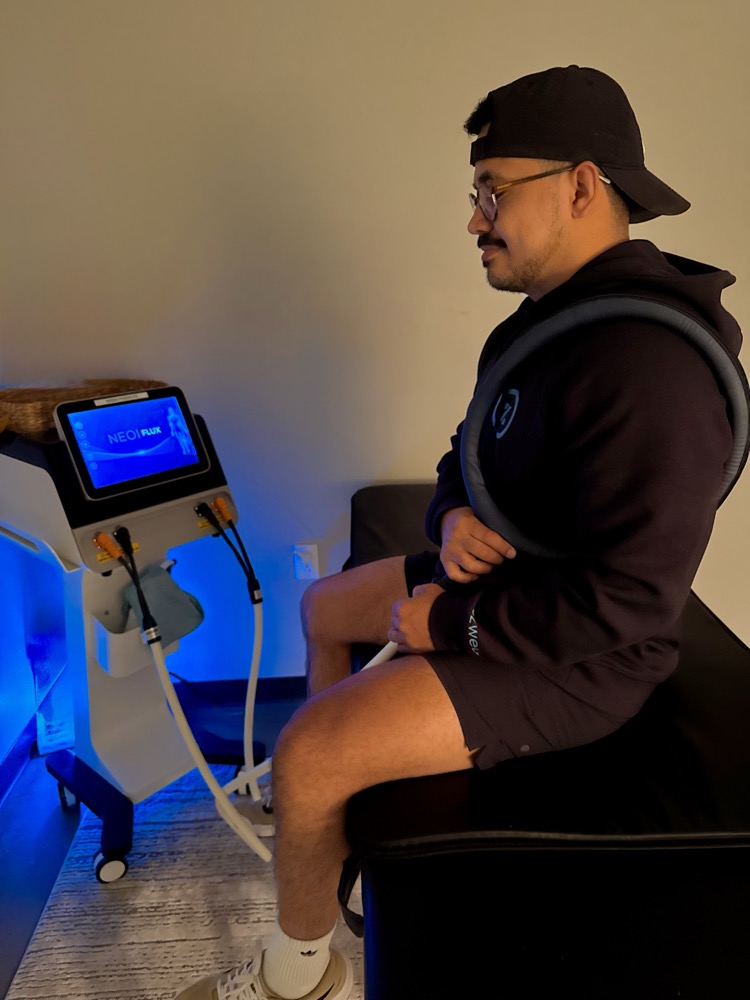
What it is
- A mat that emits low-frequency pulsed electromagnetic fields
- Twenty minutes, lying still, in a private room
- No heat, no sound, and almost nothing to feel
- The easiest thing in the recovery suite to actually do
What a session feels like
Honestly? Like lying down for twenty minutes. There's no heat, no vibration, no noise, and most people feel nothing at all while it runs. If you've come from the cold plunge, the contrast is the entire appeal — this is the one that asks nothing of you.
The room is private. Members read, nap, or stare at the ceiling, and we'd gently suggest the ceiling.
The honest science
We're going to be straighter with you about this one than the industry usually is, because PEMF is the most oversold thing in most recovery suites — including, historically, on this page.
PEMF has a real medical lineage. There are FDA-cleared devices that use pulsed electromagnetic fields, and they work for narrow, specific things: helping certain fractures heal that otherwise wouldn't, and as an adjunct after some spinal surgeries. Those are prescription devices, applied to one bone, worn for hours a day over months, under a doctor's supervision. A wellness mat you lie on for twenty minutes is not that, and the evidence for one does not transfer to the other.
For the whole-body mats — the kind we have — the picture is thin. The only systematic review to look specifically at whole-body PEMF devices concluded they could not be recommended without better evidence, and nothing published since has overturned that. On muscle recovery and soreness the trials are small, and in the handful that used a proper fake-treatment control, PEMF did not outperform the fake. On joint pain the reviews openly contradict each other: an older analysis found a benefit, later and larger ones found none, and the most recent rates the underlying studies as high risk of bias.
So the honest position is that nobody can currently tell you what a PEMF session does for you specifically. It might do something modest. It might do nothing. We offer it because it is restful, risk-free for most people, and easy to combine with the rest of a recovery day — not because we can show you it works.
Why the research is so hard to read
This part is genuinely interesting, and it explains the contradictions above. “PEMF” isn't one treatment — it's a category, the way “exercise” is a category.
Across the published trials, frequency ranges from about 1 Hz to 100 Hz, and field strength varies roughly a hundred and fifty-fold between studies. Waveform and duty cycle often go unreported entirely. Sessions run anywhere from ten minutes to an hour, once a week to daily, for one session or thirteen weeks. Pooling those into a single verdict is a bit like averaging a marathon and a set of bicep curls and reporting the effect of “exercise.”
On top of that, most trials are small, many were funded by device manufacturers, and the outcomes are usually self-reported — which matters a lot when the intervention involves lying quietly in a dim private room for twenty minutes. That is a pleasant experience whether or not the machine is doing anything.
What we won't tell you
That it's like TMS. You'll see PEMF marketed alongside transcranial magnetic stimulation, which is a genuine, FDA-cleared treatment for depression. The two are not comparable: TMS uses field strengths on the order of a thousand times greater and works by directly triggering nerve cells to fire. Low-intensity fields don't do that. PEMF is not a treatment for depression or anxiety, and anyone implying otherwise is trading on a resemblance that doesn't exist.
That it boosts your cells' energy. The ATP and “cellular energy” language is everywhere in this category. It comes from laboratory work on isolated cells, the mechanism is contested, and one recent study found effects pointing in the opposite direction to the marketing story. No human trial shows it produces more energy you'd actually notice.
That it detoxes, boosts immunity, reduces inflammation, or slows aging. There's no evidence for any of it, and regulators have taken action against PEMF marketers for exactly these claims.
Who should not use the PEMF bed
If you have any implanted electronic device, do not use the PEMF mat. That means a pacemaker, defibrillator, insulin pump, deep brain or spinal cord stimulator, or cochlear implant. Electromagnetic fields can interfere with how those devices work, and this is not a “check with us” — it's a no. Please tell a coach so we can point you at something else instead; there are five other modalities here.
Talk to your physician first if you are pregnant or nursing — safety in pregnancy hasn't been established, which isn't the same as evidence of harm, but is reason enough to wait. Also check first if you have an active cancer, a seizure disorder, a bleeding disorder, or take blood thinners. Under-18s need a parent involved.
For everyone else the safety profile is good, and adverse effects in the research are rare and minor. We're a fitness club, not a medical facility, and nothing on this page is medical advice.
Questions
How long is a PEMF session at Ozwell?
What does PEMF feel like?
Does PEMF actually work?
What is PEMF supposed to do?
Is PEMF the same as TMS?
Can I use PEMF if I have a pacemaker?
How often can I use the PEMF bed?
Who should not use the PEMF bed?
Do I need a membership to use the PEMF bed?
One of six recovery modalities at Ozwell in Carmel —
Cold Plunge · Infrared Sauna ·
Red Light Therapy · Compression ·
PEMF · mild HBOT.
See membership & pricing →
From the guides: What is PEMF therapy? A plain-English guide