Compression Therapy in Carmel, IN
Put your feet up. Literally.
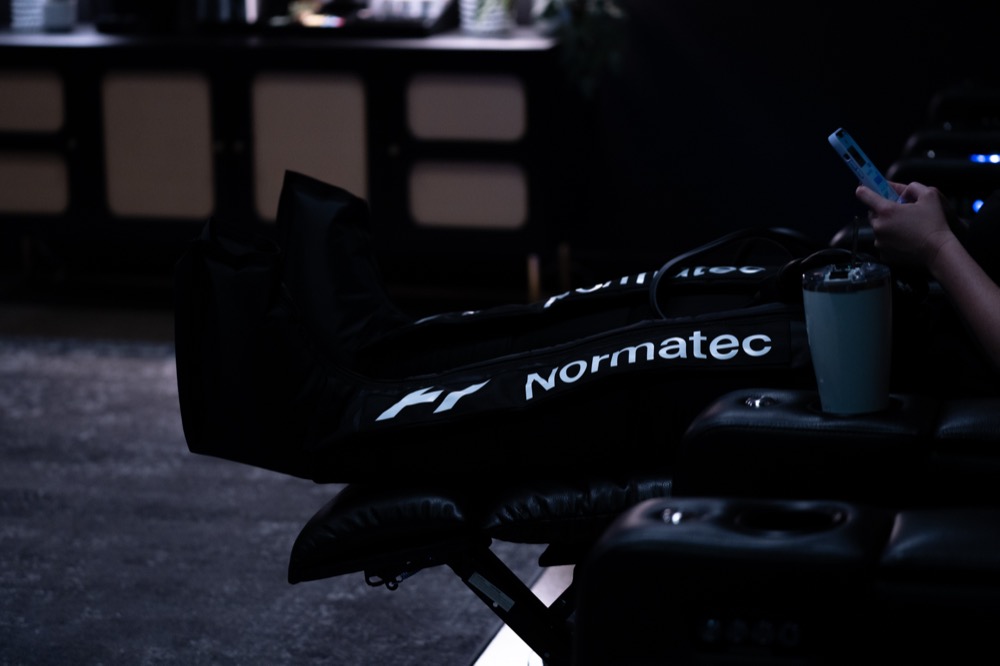
NormaTec dynamic compression at Ozwell in Carmel. It pulses through your legs, hips, or arms in waves — a firm, rhythmic squeeze that takes the heaviness out of a hard session. It lives in our quiet, dark lounge: eight stations, complimentary K-Cup coffee by the door. Bring your laptop and recover while you work.
What it helps with
- Legs that feel fresher and lighter the next day
- Less of the post-session heaviness
- A temporary loosening — you'll move a little easier straight after
- A built-in reason to actually sit still for half an hour
What a session feels like
You sit down, zip into the boots, and the chambers inflate in waves from your feet upward — a firm, rhythmic squeeze that releases and repeats. Most people describe it as oddly pleasant, somewhere between a massage and having your legs hugged by a very committed machine. It should feel like firm pressure, never pain.
Our lounge is quiet and dark, there are eight stations, and the coffee by the door is on us. Plenty of members bring a laptop and answer email through the whole thing, which is exactly the point: it is the one recovery tool that costs you no effort whatsoever.
What compression actually does — and what it doesn't
Here is the honest split, and it's a sharper split than most recovery marketing admits. The evidence that compression makes you feel better is reasonably good: two independent meta-analyses found a small-to-moderate reduction in perceived muscle soreness. There's also a well-controlled finding that it temporarily improves range of motion, and interestingly, the researchers concluded that works by raising your tolerance to pressure rather than by changing anything in the tissue.
The evidence that compression measurably improves recovery itself is weak to absent. Pooled across the research, effects on strength, power, jump height and sprint performance are trivial and statistically non-significant. Creatine kinase — the standard blood marker of muscle damage — is essentially unmoved; one review concluded it is unlikely compression affects it at all. And the two most rigorous trials, both using a convincing sham treatment, found no difference between real compression and fake compression.
That last point deserves honesty rather than burial. You cannot blind someone to having their legs squeezed, which makes this an unusually hard thing to study, and expectation is a genuine active ingredient. We think feeling recovered is a perfectly good reason to use something — it just isn't the same claim as being recovered, and we'd rather tell you which one we're selling.
About “flushing lactic acid”
You will see this everywhere. It's wrong three times over, and it's worth knowing why.
First, the timing doesn't work. Blood lactate clears on its own within roughly half an hour to an hour of finishing. If you're in the boots that evening, or two days into being sore, there is no lactate left to do anything about. Second, lactate isn't waste. It's a fuel your body actively uses — the "toxic byproduct" framing was overturned decades ago. Third, and most importantly, lactate doesn't cause next-day soreness anyway. That's eccentric muscle damage and the inflammatory response to it, not metabolite build-up.
So no, compression does not flush lactic acid, remove metabolic waste, or detox anything. It makes your legs feel better, which is a real and sufficient reason to sit in it.
Pressure, and why higher isn't better
The instinct is to crank it up. Don't — there's no evidence it helps, and reasonable evidence it doesn't. When researchers compared moderate pressure against substantially higher pressure for range of motion, the two performed the same. Both of the well-controlled trials that found nothing used some of the highest pressures in the literature. Most of the research showing benefit clusters around a moderate setting, and the studies that work best sit well below the maximum a machine can produce.
Set it firm enough to feel clearly, low enough to stay comfortable for half an hour, and leave it there. If it hurts, if your feet go numb, or if your toes change colour, stop and tell a coach.
Who should not use compression boots
Compression is the one recovery tool here with genuine hard stops, because it deliberately pushes blood back toward your heart. That's fine for most people and a real problem for some.
Do not use the boots if you have or suspect a blood clot — deep vein thrombosis — or have a history of pulmonary embolism. The warning signs of a clot are swelling, warmth, redness or pain in one leg rather than both. If that describes you today, skip the boots and call your doctor rather than a coach. Also skip them if you have congestive heart failure, severe peripheral artery disease, an active infection, a fracture or dislocation, or any open wound, sore or skin lesion where the sleeve would sit.
Check with your physician first if you're pregnant, have diabetes or nerve damage affecting sensation in your legs, or take blood thinners. Sensation matters more than people expect — the safety of the whole thing depends on you being able to feel that something is too tight.
Practical rules: never walk while wearing the attachments, don't share a session, and stay where you can reach the controls. We're a fitness club, not a medical facility, and nothing on this page is medical advice.
Questions
What is NormaTec compression therapy?
How long is a compression session?
What pressure should I use?
Does compression flush lactic acid out of your legs?
Does compression actually speed up recovery?
Should I use compression before or after training?
Can I use compression boots every day?
Who should not use compression boots?
Do I need a membership for compression?
One of six recovery modalities at Ozwell in Carmel —
Cold Plunge · Infrared Sauna ·
Red Light Therapy · Compression ·
PEMF · mild HBOT.
See membership & pricing →
From the guides: NormaTec compression — how often to use it