Guide · Field Therapy
What Is PEMF Therapy? A Plain-English Guide
The sci-fi name, translated.
PEMF might be the least self-explanatory tool in any recovery suite — the name sounds like lab equipment, the session feels like a nap, and the benefit shows up on a delay. This guide explains what pulsed electromagnetic field therapy actually is, what a session feels like, what the research does and doesn’t support, who should check with a doctor first, and how to try it at Ozwell in Carmel.
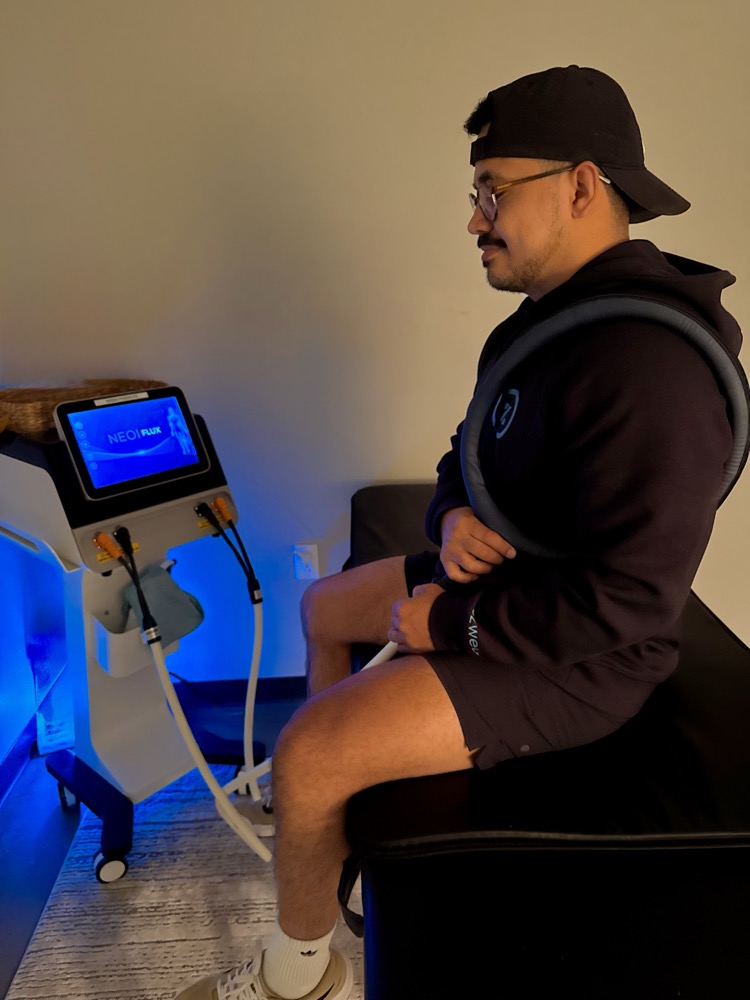
What is PEMF therapy?
PEMF stands for pulsed electromagnetic field therapy. Strip away the acronym and the idea is simple: a bed emits gentle, low-frequency electromagnetic pulses that pass deep into muscle and tissue — deeper than anything working at the skin. What those pulses actually do in the body is still an open question. Laboratory work has shown effects on cells in a dish, but the human research on PEMF for general recovery is small, inconsistent, and mostly funded by device makers — so the honest answer is that nobody can yet tell you what a session does for you specifically.
If “electromagnetic” sounds alarming, it shouldn’t — these are low-frequency pulses, nothing like an X-ray. There are no needles, no electrodes, nothing attached to you. You lie on a bed, the bed does the work, and the whole thing is closer to a rest than a treatment.
What does a PEMF session feel like?
Honestly? Not much — and that’s the part that surprises people. At Ozwell, you book the PEMF bed in a private room, lie back fully clothed, and stay still for about 20 minutes while it runs. Some people notice a subtle pulsing sensation; plenty feel nothing at all and simply enjoy twenty enforced minutes of doing nothing.
The payoff arrives on a delay. As we tell members: this is recovery you feel the next day, not the next hour. You won’t climb off the bed transformed — you’ll notice it tomorrow, in how you move.
What do members use PEMF for?
Many of our members reach for PEMF when the problem is deeper than surface-level soreness:
- Aches and persistent pain that outlast a normal recovery day
- Inflammation and stiffness, especially around joints
- Deeper muscle and joint recovery between hard training blocks
- More restful sleep — a common report, if a harder one to measure
Does PEMF actually work?
A fair question, and it deserves a straighter answer than the wellness industry usually gives. Where the research is strongest: pain and inflammation — PEMF has the best support for easing joint pain and stiffness. For recovery and sleep, the evidence is promising but still developing. We’ll always give you the honest version: this is a real tool, not a miracle. If a session leaves you moving easier the next day, that’s the benefit — and nobody should promise you more than that.
The good news is that the cost of finding out is low. A session asks nothing of you — no effort, no discomfort, no recovery from the recovery — so the sensible approach is to try it a few times, pay attention to the day after, and let your own results settle the question.
Who should skip PEMF — or talk to a doctor first?
Because PEMF works with electromagnetic fields, it doesn’t mix with implanted electronics: skip it entirely if you have a pacemaker, defibrillator, cochlear implant, or any other implanted electronic device. If you’re pregnant, get medical clearance before your first session. And if you’re managing epilepsy, a bleeding disorder, or any other health condition — or you’re simply not sure — talk to your doctor first. That conversation costs nothing.
This guide is general information, not medical advice. When in doubt, your doctor knows your situation better than any gym article does.
How to try PEMF at Ozwell
The PEMF bed at Ozwell in Carmel lives in a private room — book it, lie back, and let it run for about 20 minutes. Because it’s quiet and completely passive, it’s an easy add to any recovery day, and it stacks naturally with the other lie-down treatments: PEMF plus red light makes a calm half-hour of cellular-level work, or start a longer reset with PEMF before the infrared sauna and compression.
PEMF is one of six recovery modalities under one roof, and it’s unlimited on the Premium ($399/month) and Recovery ($299/month) memberships. Curious but not committed? Drop in for $35, or try everything for a week with the $99 trial.
PEMF FAQ
What does PEMF stand for?
What does a PEMF session feel like?
Who should avoid PEMF?
Do I need a membership to try PEMF?
Ready to feel it tomorrow?
Twenty minutes of lying still, fully clothed, in a private room — the barrier to entry doesn’t get lower. The interesting part is the next morning.
The PEMF bed is one of six recovery modalities at Ozwell in Carmel — Cold Plunge · Infrared Sauna · Red Light Therapy · PEMF. New here? Start with a day pass or see membership & pricing →