Private Hyperbaric Oxygen in Carmel, IN
Sixty quiet minutes, under pressure.
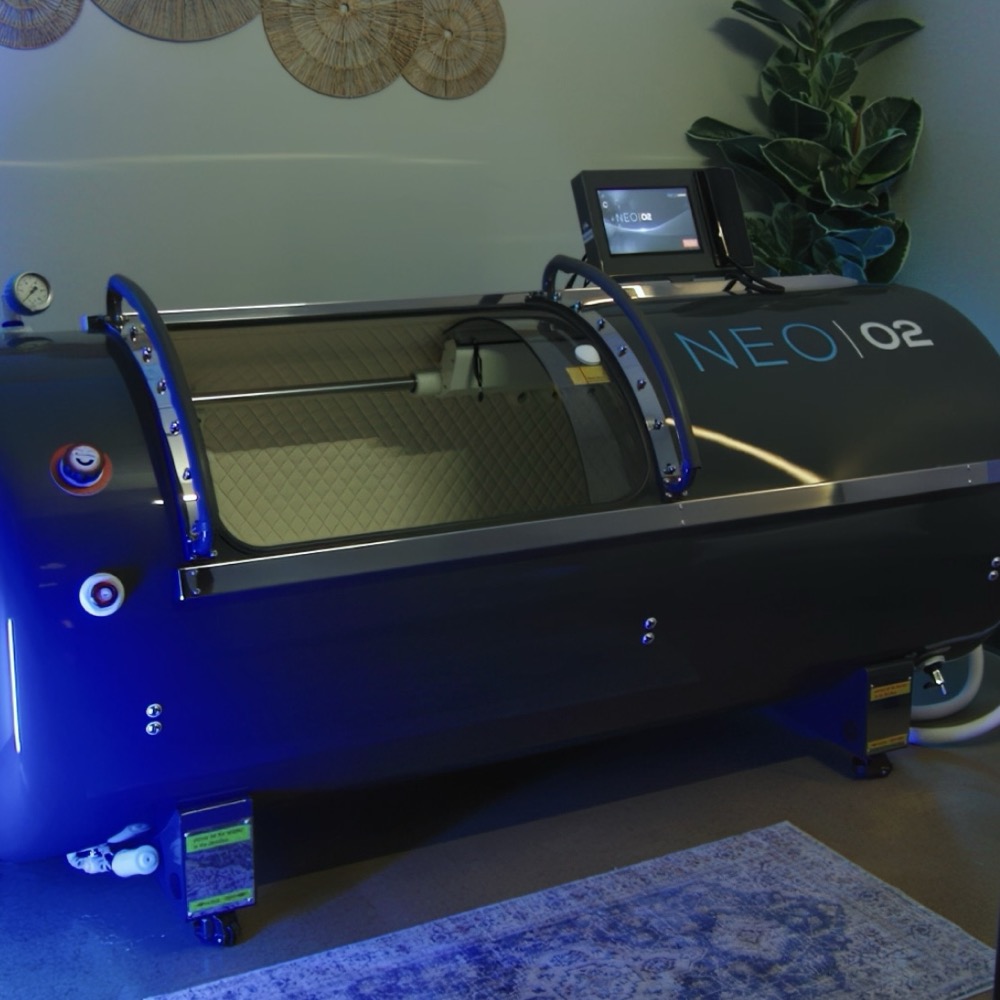
Mild hyperbaric oxygen (mHBOT) at Ozwell in Carmel. A hard-shell chamber pressurised to 1.5 times normal atmospheric pressure, running on compressed air. You recline and breathe for about an hour, and there is nothing else to do. Below, the honest version of what that does and doesn't mean.
What a session is like
- About an hour, reclined, in a private room
- The chamber pressurises slowly at the start and releases slowly at the end
- Nothing to do — bring headphones, a playlist or a nap
- You'll feel the pressure change in your ears, like a plane taking off
The only part that takes any participation is the beginning. As pressure rises you'll feel your ears fill, exactly as they do on descent in an aircraft, and you clear them the same way — swallow, yawn, or wiggle your jaw. Once you're at pressure there's nothing further to do for the rest of the hour.
What “1.5 ATA” actually means
ATA stands for atmospheres absolute — a measure of pressure, where 1.0 is what you're sitting in right now. Our chamber runs at 1.5, so about half again the pressure at sea level, roughly what you'd experience seventeen feet underwater.
Pressure matters because it changes how much oxygen dissolves directly into your blood plasma. Under ordinary conditions your haemoglobin is already carrying nearly all the oxygen it can hold — about 97% saturated — so breathing harder doesn't help. Raising the pressure is one of the few things that adds meaningfully to the oxygen dissolved in plasma.
How much you gain depends on the pressure and on what you're breathing. Our chamber runs on compressed air — ordinary air, just denser — not supplemental oxygen. At 1.5 atmospheres that roughly doubles the oxygen dissolved in your plasma. But plasma carries only a small share of the oxygen in your blood, with haemoglobin doing the rest, so the increase in total oxygen delivered to your tissues is a few percent rather than a transformation.
For contrast, hospital protocols run at two to three atmospheres breathing near-pure oxygen, which raises dissolved plasma oxygen more than tenfold. That is a genuinely different intervention, and it is the single most important thing to understand about this whole category. Anyone quoting hospital hyperbaric results at you in a wellness setting is comparing two things that are not the same.
The honest science
Let's be straight about this one, because the internet is not. Hyperbaric oxygen has a genuine, well-established medical evidence base — for around a dozen specific conditions, in hospital chambers, at two to three times atmospheric pressure. That evidence is real, and it is also not about us. Nearly all of it was produced at pressures and oxygen concentrations a wellness chamber doesn't reach, and it does not transfer downward.
For mild pressure specifically, the research is thin and the better-designed trials are discouraging. When mild hyperbaric sessions have been tested against a convincing sham in properly blinded studies — for long COVID, and in a series of military-funded trials for persistent concussion symptoms — they have generally not outperformed the placebo. There is some evidence that hyperbaric sessions reduce blood markers of muscle damage after hard exercise, though the same analysis found no improvement in how sore people actually felt, and the useful results came from clinical pressures rather than mild ones.
So we're not going to tell you this is medicine, or recovery, or anti-aging. What we can honestly offer is an hour that most members find genuinely restorative, in a quiet private room, where the only thing asked of you is to lie still and breathe. If you have a health condition, talk to your doctor rather than to us.
What we won't claim
That it reverses aging or lengthens telomeres. This is the most-quoted study in the industry and it deserves scrutiny: it had no control group, no randomisation, no blinding, about twenty-five people in the analysis, ran at 2.0 atmospheres on pure oxygen, and several authors held a commercial interest in the protocol being sold. It is not a basis for anything, least of all at mild pressure.
That it treats any disease. Not cancer, not Alzheimer's, not Lyme, not autism, not long COVID, not concussion. Regulators have issued consumer warnings specifically because wellness facilities market chambers for these things, and we're not going to be one of them.
That it “oxygenates your cells” or detoxes anything. The first is a slogan rather than a mechanism, and the second isn't a measurable claim at all.
Your ears, which is the part that actually matters
Ear discomfort is by a wide margin the most common issue people have in a hyperbaric chamber — more common than most facilities mention — and it's almost entirely preventable.
The mechanism is simple: as pressure rises, it presses inward on your eardrum, and you need to let air up the eustachian tube to equalise. Swallow, yawn, or move your jaw side to side, early and often, from the moment the descent begins. Don't wait until it hurts — once the pressure difference builds, equalising gets harder rather than easier. If you can't clear, say so immediately and we'll slow or pause the descent. That's normal and it's what the operator is there for.
Don't use the chamber with a cold, blocked sinuses or allergies flaring. Congestion is exactly what stops you equalising, and pushing through it is how people end up with a genuinely painful ear injury. Reschedule — it isn't worth it.
Why compressed air matters for safety
There's a reason we mention what's in the chamber. Hyperbaric fires have been in the news, and the pattern behind them is consistent: an oxygen-enriched environment, usually a soft-sided chamber run with an oxygen concentrator, where a spark that would be harmless in ordinary air becomes catastrophic. Fire needs oxygen, and enriching the atmosphere is what turns a chamber into a hazard.
Ours is a hard-shell chamber on compressed air. The atmosphere inside is the same 21% oxygen you're breathing right now, just at higher pressure — so it never becomes an oxygen-enriched environment, and that entire failure mode doesn't apply. It also means the honest ceiling on what this can do is lower than a clinical chamber's. We'd rather have it that way, and we'd rather you knew.
Who should not use the chamber
An untreated collapsed lung — a pneumothorax — is an absolute contraindication. Air trapped in the chest expands as pressure releases, which can be life-threatening. If you've ever had one, or have any lung condition that traps air, you need a physician's clearance before going anywhere near a chamber.
Also talk to your doctor first if you have had recent ear or sinus surgery, have ear tubes, uncontrolled seizures, severe COPD, uncontrolled diabetes, or are pregnant. Tell us if you have claustrophobia — it's common, it's not embarrassing, and knowing in advance lets us show you the chamber and the intercom before you're in it. Certain chemotherapy drugs interact with hyperbaric exposure, so if you're in treatment or recently finished, that's a conversation for your oncologist.
We're a fitness club, not a medical facility. Nothing on this page is medical advice, and we're not able to assess whether hyperbaric exposure is appropriate for a medical condition — that's your physician's call, and we'd rather you ask them.
Questions
Is this the same as medical hyperbaric oxygen therapy?
What does 1.5 ATA mean?
Do I breathe pure oxygen in the chamber?
How long is a hyperbaric session at Ozwell?
Will my ears hurt?
Can I use the chamber if I have a cold or blocked sinuses?
Does mild hyperbaric help with recovery?
Is it claustrophobic?
Who should not use the hyperbaric chamber?
Do I need a membership to use the hyperbaric chamber?
One of six recovery modalities at Ozwell in Carmel —
Cold Plunge · Infrared Sauna ·
Red Light Therapy · Compression ·
PEMF · mild HBOT.
See membership & pricing →
From the guides: Contrast therapy: sauna & cold plunge order